I recently had the privilege to visit Shackleton’s hut at Cape Royds,
erected for the Nimrod expedition in 1908. Shackleton, with three of his men and four ponies, marched out from this hut to attempt to reach the South Pole. They reached a latitude of 88° 23’S, a record at the time and less than 100 miles from their goal. At Cape Royds the shelves are still stocked with all sorts of intriguing supplies, carefully restored and conserved by the New Zealand Antarctic Heritage Trust. From candles to cod roe, suet to syrup, all manner of turn-of-the-century delicacies line the shelves. But the medical supplies in particular caught my attention.
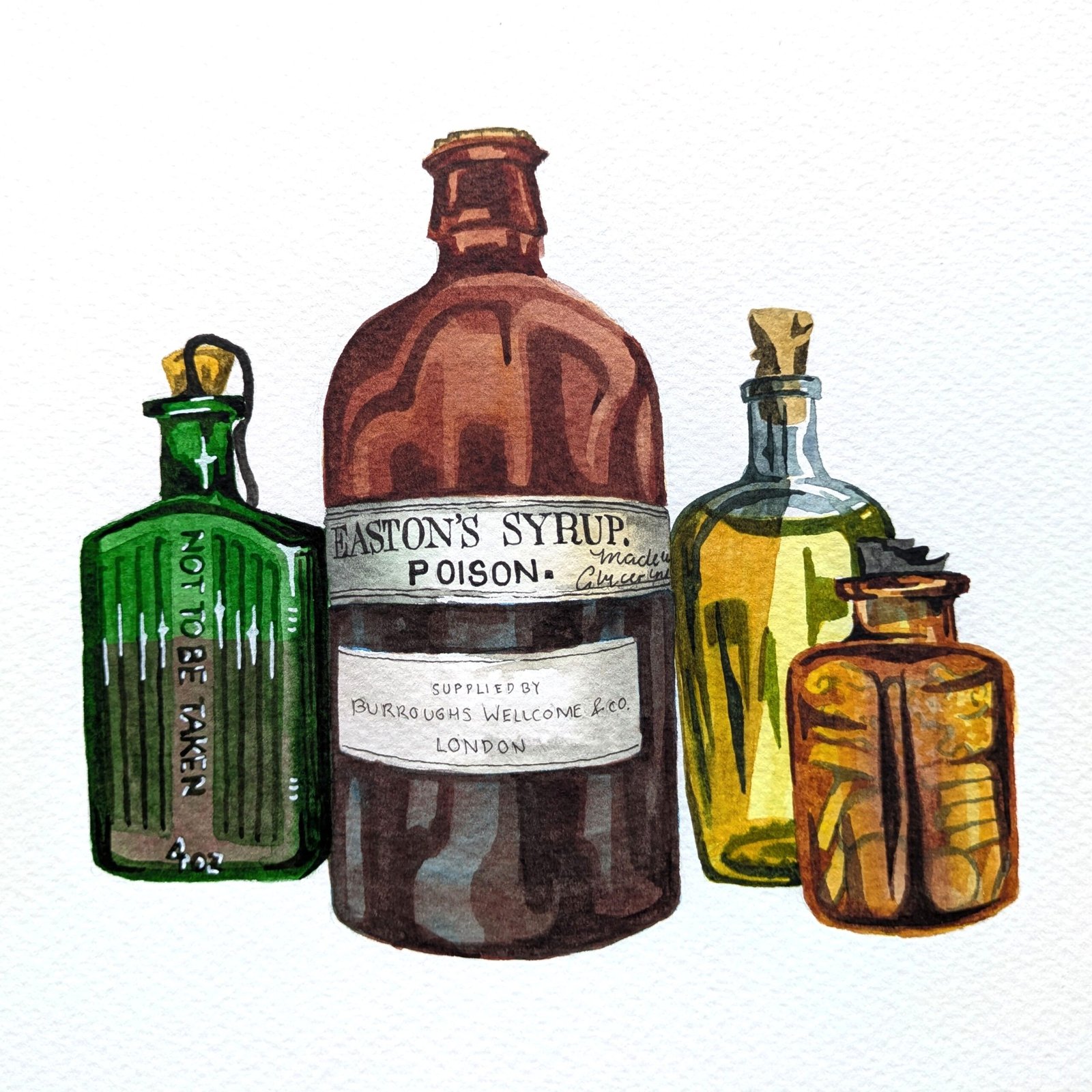
In today’s world we are used to targeted medicines to solve specific problems. But wind the clock back 100 years and a typical pharmacy stocked a wide range of tonics. These mysterious preparations were dosed out to treat a feeling as much as an objective diagnosis. Malaise, stupor, and ennui might have one reaching for the medical bag to retrieve tincture of gentian, strychnine or quinine. Reading the ingredients listed on the stoppered bottles had me thinking of medieval alchemists more than modern-day pharmacists. Camphor, red bone marrow and nut gall don’t come in blister packs or plastic tubs, but in weighty glass vials and bottles now gathering ice crystals in the hut.
It’s incredible to think of these men facing the Antarctic elements with these unreliable remedies to treat their various ailments. But some are more familiar – “Forced March” tablets contained caffeine and cocaine for a little extra energy on hard days of sledging. “Paregoric” tablets were a preparation of opium for pain, and brandy and whisky belonged in the medicine chest more than at the drinking table. But a word of caution for anyone thinking of trying the “Blue Pills” found in the hut – in Shackleton’s day this had a rather different meaning, being a tablet of mercury to treat constipation…
For a more in-depth look at the supplies taken along for these expeditions of the Heroic Age of Antarctic Exploration take a look at the fantastic series of papers by Dr Guly and funded by the Wellcome Trust: Guly HR. Medical supplies for the expeditions of the heroic age of Antarctic exploration: introduction. Pharm Hist (Lond). 2012 Jun;42(2):32-6. PMID: 23045792. https://pubmed.ncbi.nlm.nih.gov/23045792/